

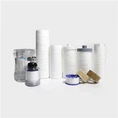
The manufacturing process of PP meltblown filter cartridges is a process that uses food-grade polypropylene (PP) as raw material, and through steps such as high-temperature melting, high-speed spinning, fiber web formation, and hot-melt shaping, to produce a deep filtration material with a gradient pore structure of "loose on the outside and dense on the inside".
Core Manufacturing Process: Four Key Steps
The production of PP meltblown filter cartridges is a highly automated system engineering project, mainly divided into the following four stages:
1. Raw Material Preparation and Drying
* High-purity food-grade polypropylene granules are used as raw materials to ensure they are non-toxic, odorless, and meet drinking water safety standards.
* The raw materials must be dried before input to remove moisture and prevent the formation of bubbles or affecting fiber uniformity during high-temperature melting.
2. Melt Spinning: High-Temperature Melting + High-Speed Hot Airflow Stretching
* Polypropylene granules enter the screw extruder and melt into a viscous flow state at a high temperature of 230–260℃.
* The melt is extruded through the spinneret orifice and simultaneously subjected to high-speed hot air at 340–370℃ from both sides, causing the melt to be extremely stretched, forming ultrafine fibers with a diameter of only 1–4 micrometers.
* This process, known as "meltblown," is crucial for determining fiber fineness and pore structure.
3. Fiber Web Formation and Receiving Formation
* The broken ultrafine fibers fall randomly under the influence of airflow and coalesce on a rotating receiving drum or web-forming curtain, forming a three-dimensional porous fiber web.
* The receiving distance (distance from the nozzle to the drum surface) is adjustable, used to control fiber density and filter thickness.
* The fibers are thermally bonded using their own residual heat and hot air, eliminating the need for chemical adhesives and ensuring material purity.
4. Curing, Shaping, and Post-processing
* After cooling and curing, the fiber web is wound into a tubular structure and then cut, engraved, and packaged as needed.
* Optional processing includes:
Grooving/Embossing: Increases surface area and improves dirt-holding capacity.
Skeleton Reinforcement: An internal PP or stainless steel support layer enhances compressive strength, suitable for high-pressure systems.
Hydrophilic modification: Improves the separation efficiency of oil-water mixtures, expanding its application to industrial oily wastewater treatment scenarios.
Key Technical Features: Why can it achieve high-efficiency filtration?
| Features | Description |
| Graded Pore Structure | Loose outer fibers intercept large particles; dense inner fibers capture tiny impurities, achieving "graded filtration" |
| Three-Dimensional Microporous Network | Randomly interwoven fibers form numerous tortuous channels, possessing high porosity (>75%) and large dirt-holding capacity |
| Physical Deep Filtration | Relying on mechanical interception and "bridging phenomenon" between fibers, it can capture particles smaller than the nominal precision |
| One-Piece Molding | Seamless overall structure, no adhesives, avoiding secondary contamination, and meeting FDA food-grade requirements |
Typical Equipment and Parameters (Taking a fully automated production line as an example)
* Main machine power: Approximately 16–55kW, dual main machine configuration increases output
* Production speed: Up to 3800–4000 cartridges/24 hours, supports continuous operation
* Adjustable parameters:
Filtration accuracy: 0.5–150μm (commonly 1, 5, 10, 20μm)
Length: 10″, 20″, 30″, 40″ (approximately 25–100cm)
Outer diameter: 60–115mm, Inner diameter: 28–30mm
* Control system: PLC fully automatic control, ensuring process stability and product consistency
Extended Application Scenarios
PP meltblown filter cartridges, due to their strong chemical stability (pH 1–13), high temperature resistance, and lack of leachables, are widely used in:
* Household water purifiers: As the first-stage pre-filtration, removing sediment and rust.
* RO reverse osmosis systems: Pre-filtering to protect the expensive RO membrane.
* Pharmaceutical and food industries: Precision filtration of injections, oral liquids, and beverages.
* Electronic ultrapure water preparation: Intercepting particulates to ensure the cleanliness of water used in chip manufacturing.
* Industrial fluid filtration: Suitable for complex media such as acid and alkali solutions, electroplating solutions, and organic solvents.
https://www.angefilter.com/