

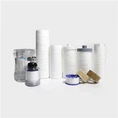
Choosing the right PP wound filter cartridge requires comprehensive consideration of its gradient filtration structure ("loose on the outside, dense on the inside"), the fluid characteristics of the target application scenario, and the replacement cycle based on water quality and pressure differential.
Selection Based on Filtration Structure: Matching Accuracy and Contaminant Holding Capacity
The core advantage of PP wound filter cartridges lies in their deep gradient filtration structure. Polypropylene fiber yarns are precisely wound onto a porous framework, forming a honeycomb-like channel that gradually densifies from the outside in, achieving a balance between high-efficiency interception and high contaminant holding capacity.
1. Filtration Accuracy (0.5–100μm) Determines Interception Capacity
* 1–5μm: Suitable for high-cleanliness requirements, such as RO reverse osmosis pre-filters and electronic ultrapure water systems, capable of intercepting tiny colloids and fine particles.
* 10–20μm: A general-purpose option, suitable for pre-filtration of drinking water and food/beverage products, balancing flow rate and filtration efficiency.
* 50–100μm: Used for coarse filtration, such as industrial circulating water and cooling water systems, primarily removing large particles of sediment and rust.
2. Winding Density and Yarn Thickness Affect Performance
* Fineer yarn and tighter winding result in higher precision, but lower flow rate and increased clogging.
* It is recommended to choose a slightly lower precision (e.g., 5μm instead of 1μm) while still meeting filtration requirements to extend lifespan and reduce replacement frequency.
Selection Based on Applicable Scenarios: Adapting to Fluid Properties and Operating Conditions
Different industries have varying requirements for the chemical compatibility, temperature resistance, and mechanical strength of filter cartridges, necessitating the selection of specific material combinations.
| Application Areas | Recommended Filtration Accuracy | Frame Material | Key Requirements | Typical Uses |
| Household/Commercial Water Purification | 5–10μm | Polypropylene (PP) | Food-grade safety, pressure-resistant and stable | Pre-filtration for RO systems, security filtration for drinking water machines |
| Food and Beverage Production | 1–5μm | Stainless Steel (304/316) | Resistant to organic solvents, easy to clean | Clarification filtration for beer, juice, and syrup |
| Electronics and Semiconductors | 0.5–1μm | Stainless Steel | High cleanliness, low particle shedding | Ultrapure water systems, developer filtration |
| Chemical/Electroplating | 5–20μm | Stainless Steel | Resistant to acids and alkalis (pH 2–13), high temperature | Purification of electroplating solutions, cleaning agents, and etching solutions |
| Pharmaceutical/Biotechnology | 1–5μm | Polypropylene or Stainless Steel | Non-toxic, odorless, sterilizable | Pretreatment of water for injection, filtration of pharmaceutical solutions |
Special Note: If the filtered liquid contains organic solvents or is at a high temperature (>80℃), avoid using a PP frame. Instead, choose a combination of a stainless steel frame + degreased cotton or glass fiber filter media.
Management Based on Replacement Cycle: Scientifically Judging Service Life
The replacement cycle for PP wound filter cartridges is not fixed and needs to be determined comprehensively based on operating pressure differential, water quality conditions, and usage time.
1. Differential Pressure Monitoring: The Most Reliable Basis for Replacement
* When the differential pressure across the filter cartridge reaches 2.4 bar (approximately 0.24 MPa), it indicates saturation and should be replaced immediately.
* It is recommended to install a pressure gauge in the system and regularly record the inlet and outlet pressures for trend analysis.
2. Water Quality Affects Service Life
* Highly polluted water sources (such as well water, old pipe networks): Replacement cycle may be shortened to 1–3 months.
* Municipal tap water: Generally usable for 3–6 months.
* Industrial circulating water: Depending on the contaminant concentration, replacement is usually required every 2–4 months.
3. Time Reference and Intelligent Reminders
* Even if the differential pressure does not reach the threshold, the maximum usage period should not exceed 12 months to prevent microbial growth or material aging.
* Users of smart water purifiers can rely on the filter life reminder function to adjust the replacement schedule based on actual water quality.
https://www.angefilter.com/