

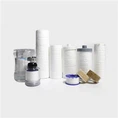
To judge whether the PP melt-blown filter element needs to be replaced, you can start from the following aspects:
Filtering effect
1. Observe the water quality or air quality
Water filtration application: If it is used for water filtration, such as in drinking water treatment, industrial pure water preparation or sewage treatment, when the filtered water becomes turbid, discolored, odorous, or the visible impurities in the water increase significantly, it is likely that the filter element has failed and needs to be replaced. For example, the originally clear and transparent drinking water becomes a little white or has fine particles suspended after being filtered by the filter element, which indicates that the filter element may not be able to effectively intercept impurities in the water.
Air filtration application: In the field of air purification, if it is found that the filtered air still has obvious dust, odor or pollutants, or the indoor air quality monitoring indicators (such as PM2.5 concentration, harmful gas content, etc.) have not been significantly improved or even deteriorated, it also indicates that the filter element may need to be replaced. For example, if you use an air purifier on a smoggy day and still feel that the indoor air is not fresh enough and there is a noticeable sense of particulate matter when you breathe, it may be that the filter element is saturated and can no longer effectively filter pollutants in the air.
2. Detect key indicators before and after filtration
Water filtration system: For some applications with high water quality requirements, such as ultrapure water preparation in the process of electronic chip manufacturing, professional water quality testing instruments can be used to regularly test the content of specific pollutants (such as particulate matter quantity, organic matter content, heavy metal ion concentration, etc.) in the water before and after filtration. When it is found that the content of these key indicators in the filtered water is close to or exceeds the prescribed limit, it means that the filtration capacity of the filter element has decreased and the filter element needs to be replaced to ensure that the water quality meets production requirements.
Air filtration system: In air filtration in industrial production environments, such as dust-free workshops in pharmaceutical factories and electronics factories, indicators such as particulate matter concentration (such as using a laser dust particle counter) and microbial count (through air planktonic bacteria sampler and culture analysis) in the air before and after filtration can be detected. If these indicators after filtration do not meet the workshop cleanliness standards, it means that the filter element needs to be replaced to maintain the air quality of the production environment.
Equipment operating parameters
1. Pressure difference changes
Pressure difference monitoring principle: During the use of PP melt-blown filter elements, as impurities gradually accumulate on the surface and inside of the filter element, the resistance of the fluid passing through the filter element will increase, resulting in an increase in the pressure difference before and after the filter element. Most filtration equipment is equipped with a pressure difference gauge or a pressure difference sensor to monitor this parameter.
Pressure difference alarm value setting: During the initial installation and commissioning of the equipment, a normal working pressure difference range and a pressure difference alarm value will be set according to the characteristics of the filter element and system requirements. When the pressure difference reaches the alarm value, it means that the filter element has retained a lot of impurities, the filtration efficiency has decreased, and the filter element needs to be replaced in time. For example, under normal circumstances, when the pressure difference before and after the filter element reaches 1.5-2 times the initial pressure difference, the filter element should be considered for replacement. Different filtration systems and application scenarios may have different specific pressure difference alarm values.
2. Flow Change
Flow monitoring of water filtration system: In water filtration equipment, if the water flow after filtering by the filter element is found to be significantly reduced, and other factors (such as changes in water supply pressure, pipe blockage, etc.) are excluded, it is likely that the filter element is blocked. This may be due to excessive accumulation of impurities on the surface of the filter element, which hinders the flow of water. For example, in a normally operating reverse osmosis pure water preparation system, if it is found that the water flow rate is gradually reduced and is lower than a certain proportion of the system design flow rate (such as 70% - 80%), after checking that other related components are normal, it should be considered to replace the PP melt-blown pre-filter element to restore normal water flow.
Air volume monitoring of air filtration system: For air filtration equipment, such as air filters of air conditioning systems or filters of ventilation equipment, if the air volume at the outlet is significantly reduced when the fan speed remains unchanged, or the resistance of the ventilation system increases, it may also be a signal that the filter element needs to be replaced. This may be because a large amount of impurities such as dust and particulate matter have accumulated on the filter element, affecting the circulation of air. For example, in the central air conditioning system of a large shopping mall, if it is found that the air supply volume on each floor is significantly reduced, resulting in uneven indoor temperature distribution or reduced comfort, after checking that the fan and ventilation duct are fault-free, it is necessary to check and replace the PP melt-blown filter element in the air filter.
Usage time and frequency
1. Replace according to the recommended service life
Manufacturer recommendation: The manufacturer of the PP melt-blown filter element usually provides a rough service life recommendation value based on the material, structure, filtration accuracy and test data of the filter element in different application scenarios. For example, in a general household drinking water filtration system, the service life of the PP melt-blown filter element may be 3-6 months; while in an industrial environment, depending on the severity of the water or air quality, the service life may range from a few days to several months. If the use environment is relatively harsh, the impurity content in the water is high, the concentration of air pollutants is high, or the filtration system runs for a long time and at a high frequency, the actual service life of the filter element may be shorter.
2. Record usage time and frequency
Establish maintenance records: In order to more accurately determine the replacement time of the filter element, users can establish a maintenance record of the filter system, recording in detail the installation time of the filter element, the duration of each use, the frequency of use (such as the number of hours used per day, the number of days used per week, etc.) and the relevant parameters of the filter medium (such as the source water quality of the water, the approximate composition and concentration of pollutants in the air, etc.). By analyzing these data, the replacement cycle of the filter element can be better predicted. For example, if an office air purifier runs continuously for 8-10 hours a day, under the condition of general air quality, after a period of recording and observation, it may be found that the PP meltblown filter element needs to be replaced every 3-4 months to ensure a good purification effect.
Filter element appearance inspection
1. Observe the surface of the filter element
Color change: After the filter element has been used for a period of time, if the surface color is found to be significantly darker, or even black, brown and other stains appear, this usually indicates that the filter element has absorbed a large amount of impurities and may need to be replaced. For example, in water treatment, if the PP melt-blown filter element is originally white and turns yellow or brown after a period of use, it may be that organic matter, iron-manganese oxides and other impurities in the water are adsorbed on the surface of the filter element.
Visible impurity accumulation: Directly observe the surface of the filter element. If you see a large amount of impurities such as particulate matter, silt, fiber, etc. attached and cannot be removed by simple cleaning, this is also a sign that the filter element needs to be replaced. This phenomenon may be more obvious in filter elements used in some environments with poor water quality or heavy air dust. For example, PP melt-blown filter elements used for industrial wastewater pretreatment may accumulate a thick layer of silt and suspended matter on the surface, seriously affecting the filtration effect.
2. Check the integrity of the filter element
Physical damage: Regularly check the filter element for physical damage such as breakage, cracks, and deformation. If the filter element has these problems, it will not only lead to a decrease in filtration effect, but also allow unfiltered impurities to pass directly through the filter element into the downstream, affecting the normal operation of the entire system. For example, during the installation or removal of the filter element, improper operation may cause damage to the filter element; or under the action of long-term high pressure difference, the filter element may also rupture.
Fiber shedding: Gently shake the filter element to observe whether there is any fiber shedding. If the filter element is found to have fiber shedding, these shed fibers may enter the filtered medium and cause secondary pollution. At this time, the filter element also needs to be replaced. Especially in some applications with extremely high purity requirements, such as ultrapure water preparation in the electronics industry or sterile air filtration in the pharmaceutical industry, fiber shedding of the filter element is absolutely not allowed. Once found, the filter element must be replaced immediately.
Through the comprehensive judgment of the above multiple aspects, it can be more accurately determined whether the PP melt-blown filter element needs to be replaced, thereby ensuring the stable operation of the filtration system and the effectiveness of the filtration effect. In actual operation, different application scenarios and filtration requirements may focus on different judgment methods, but usually a comprehensive evaluation based on multiple factors is required.
https://www.angefilter.com/