

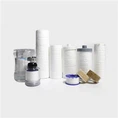
To extend the service life of PP melt-blown filter elements, you can start from the following aspects:
Pretreatment
1. Install a pre-filter
Principle and function: Install a pre-filter before the main PP melt-blown filter element, such as a coarse filter or a bag filter, to remove larger particles of impurities in advance and reduce the filtering burden of the PP melt-blown filter element. The pre-filter can intercept impurities such as silt, rust, and large suspended particles to prevent these large particles from directly entering the PP melt-blown filter element, thereby reducing the clogging rate of its surface and internal pores and extending the service life of the filter element.
Choose a suitable pre-filter: According to the specific needs of the filtration system and the characteristics of the filtered medium, select a pre-filter with appropriate filtration accuracy and material. For example, for raw water filtration with poor water quality and high silt content, a bag filter with a filtration accuracy of 50-100 microns can be selected as a pre-filter; for environments with more dust in the air, a G4-level primary filter can be selected as a pre-filter to effectively remove most of the larger dust particles.
2. Sedimentation or flocculation treatment (for liquid filtration)
Sedimentation treatment: For liquids containing a large number of suspended solid particles, if conditions permit, sedimentation treatment can be performed first. Let the liquid stand in the sedimentation tank for a period of time, so that the larger particles of impurities naturally settle to the bottom of the pool under the action of gravity, and then filter the supernatant through the PP melt-blown filter element. This can greatly reduce the total amount of impurities entering the filter element and reduce the risk of filter element clogging. For example, in the primary treatment stage of a sewage treatment plant, a sedimentation process is often used to remove most of the silt and suspended solids in the sewage, reducing the burden for subsequent deep filtration (including PP melt-blown filter element filtration).
Flocculation treatment: Add an appropriate amount of flocculant to the liquid to make the fine particles and colloidal substances in the water condense into larger flocs, which is convenient for subsequent sedimentation or filtration separation. Flocculants can neutralize the charge on the surface of the particles, causing them to adsorb each other and form larger particle clusters. Commonly used flocculants include polyaluminum chloride (PAC), polyacrylamide (PAM), etc. In some industrial wastewater treatment, after flocculation and sedimentation pretreatment, filtration through PP melt-blown filter element can significantly improve the service life and filtration effect of the filter element.
Operation and management of filtration system
1. Control the filtration flow rate
The impact of flow rate on filter element: Too fast filtration flow rate will increase the impact of fluid on the filter element, making it easier for impurities to penetrate the deep structure of the filter element, resulting in faster internal blockage of the filter element. It may also damage the fiber structure of the filter element and reduce its filtration performance and service life. Too slow flow rate may affect production efficiency or the normal operation of the system, but appropriately reducing the flow rate within a certain range will help extend the life of the filter element.
Reasonable adjustment of flow rate: According to the specifications and materials of the filter element and the design requirements of the filtration system, the filtration flow rate can be controlled within a suitable range by adjusting the pump speed (in the liquid filtration system) or the fan air volume (in the air filtration system). Generally speaking, the recommended flow rate of PP meltblown filter elements varies in different application scenarios, but usually in water filtration, the flow rate can be controlled at about 10-15 cubic meters per hour per square meter of filtration area; in air filtration, the surface velocity can be controlled between 0.1-0.5 meters per second. The specific optimal flow rate needs to be optimized and adjusted according to the actual situation.
2. Regular backwashing or backflushing (if applicable)
Backwashing principle (for liquid filtration): For some PP meltblown filter elements that can be backwashed, regular backwashing operations can effectively remove impurities accumulated on the surface of the filter element and in some internal pores. Backwashing is to use reverse water flow through the filter element to wash away impurities adsorbed on the filter element. During the backwashing process, the water flow direction is opposite to the normal filtration direction, so that impurities are separated from the filter element under the action of the reverse water flow. For example, in some industrial circulating water filtration systems, regular backwashing of PP meltblown filter elements (such as every week or every two weeks) can significantly extend their service life and reduce the frequency of replacement.
Backflush principle (for air filtration): In the air filtration system, if the filter element has a backflush function, compressed air can be used for regular backflush. During backflush, compressed air is blown out from the inside of the filter element in an instantaneous high-speed airflow to blow off dust and other impurities attached to the outer surface of the filter element. The backflush pressure and time interval need to be reasonably set according to the characteristics of the filter element and the actual use. For example, the PP melt-blown coated filter element used in the bag filter can be backflushed regularly according to the pressure difference to maintain the air permeability and filtration efficiency of the filter element and extend its service life. Generally speaking, the backflush pressure can be controlled between 0.3 and 0.6MPa, and the backflush time interval can range from a few minutes to a few hours depending on the working conditions.
Maintenance
1. Regularly check and clean the filter housing and related components
The importance of housing cleaning: If dust, dirt or other impurities accumulate on the filter housing and connecting pipes and other components, they may fall off during operation and enter the filter element, accelerating the clogging of the filter element. Regular cleaning of these components can keep the overall cleanliness of the filtration system and reduce the impact of external impurities on the filter element.
Inspection and cleaning frequency and method: According to the use environment and system operation, formulate a reasonable inspection and cleaning plan. For example, in a dusty industrial environment, the filter housing should be inspected and cleaned every week or every two weeks; in a general environment, it can be done once a month or every quarter. When cleaning, you can wipe the surface of the housing with a damp cloth. For difficult-to-remove dirt, you can use a mild detergent to clean it, but be careful to avoid detergent residues from contaminating the filtration system. At the same time, check whether the connecting pipes are well sealed and whether there are any leaks or looseness. If there are any problems, repair them in time.
2. Correctly install and replace the filter element
Installation precautions: When installing the PP melt-blown filter element, ensure that the operation is correct to avoid damaging the filter element. First, check the integrity of the filter element to ensure that there are no defects such as breakage and cracks. During the installation process, pay attention to the installation direction of the filter element. Generally, there will be obvious arrows on the filter element to indicate the direction of water flow or air flow. It must be installed in the correct direction, otherwise it will affect the filtration effect and may damage the filter element. At the same time, use appropriate tools to avoid squeezing or twisting the filter element with excessive force. When tightening the filter element housing, operate according to the specified torque to prevent the housing from being too tight or too loose, causing leakage or deformation of the filter element.
Key points for replacing the filter element: When the filter element needs to be replaced, the relevant valves or equipment of the filtration system should be closed first, and the system pressure should be completely released before operation. When removing the old filter element, be careful to avoid spilling the residual impurities in the old filter element. Before installing a new filter element, the inside of the filter should be thoroughly cleaned to ensure that no impurities remain. After the new filter element is installed, it should be properly flushed or pre-run to remove the air and a small amount of impurities that may exist inside the filter element before it is officially put into use.
Optimization of the operating environment
1. Keep the environment clean
Reduce the source of dust and impurities: Try to keep the environment around the filtration system clean, and reduce the generation and entry of impurities such as dust and particulate matter. For air filtration systems, if air purifiers are installed indoors, keep the indoor floor clean, sweep and mop the floor regularly, and reduce dust generated by human activities. For air filtration equipment in industrial production, sealing measures can be taken to prevent a large amount of external dust from entering the filtration system. In liquid filtration systems, for containers and pipes storing liquids, ensure that they are well sealed to prevent external impurities from mixing in.
Control humidity and temperature (if applicable): In some special filtration applications, the humidity and temperature of the environment also have a certain impact on the service life of the filter element. For example, in a high temperature and high humidity environment, certain impurities may be more likely to breed microorganisms or chemically react on the surface of the filter element, causing the filter element to be blocked or damaged. If possible, the humidity and temperature of the operating environment of the filtration system should be controlled within an appropriate range. For some humidity-sensitive filtration systems, such as ultrapure water preparation systems in the electronics industry, dehumidification equipment can be equipped to control the ambient humidity at a lower level (such as 40% - 60% RH) to extend the service life of the PP meltblown filter element.
2. Avoid frequent start and stop of the filtration system
Hazards of frequent start and stop: Frequent start and stop of the filtration system will cause a certain impact on the filter element. Each time it is started, the sudden impact of the fluid may cause the fiber structure inside the filter element to shift or damage, and it will also cause uneven deposition of impurities on the surface of the filter element, accelerating the local blockage of the filter element. Moreover, during the start and stop of the system, changes in pressure and flow rate will also have an adverse effect on the performance of the filter element.
Reasonably arrange the operation time: According to actual production or use needs, try to formulate a reasonable filtration system operation plan to reduce unnecessary start and stop times. For example, in the production process of the factory, if the operation time of the production equipment is relatively fixed, the filtration system can be synchronized with the production equipment to avoid frequent start and stop of the filtration system in a short period of time. For some filtration systems with high continuous operation requirements, such as the core filtration unit of the sewage treatment plant, they should try to maintain their stable operation and reduce frequent start and stop due to equipment maintenance or other reasons.
Water quality or air quality monitoring
1. Regularly monitor water quality or air quality
The significance of monitoring: By regularly monitoring the quality changes of the filtered medium (water or air), the operating effect of the filtration system can be understood in time, potential problems can be found, and the operating parameters of the filtration system can be adjusted or corresponding maintenance measures can be taken according to the monitoring results, which will help extend the service life of the filter element. For example, if it is found that the impurity content in the water suddenly increases or the concentration of pollutants in the air exceeds the standard, it may be caused by changes in the upstream process or external environmental factors. At this time, timely measures can be taken, such as strengthening pretreatment or checking whether there are leaks in the filtration system, so as to avoid premature failure of the filter element due to excessive load.
Monitoring indicators and methods: For water quality monitoring, common indicators include particulate matter concentration, turbidity, organic matter content, heavy metal ion concentration, etc., and corresponding water quality testing instruments and methods can be used for regular testing, such as using a turbidity meter to measure the turbidity of water, and determining the organic matter and heavy metal content by chemical analysis methods. In terms of air quality monitoring, the main monitoring indicators include the concentration of particulate matter (such as PM2.5, PM10), the content of harmful gases (such as sulfur dioxide, nitrogen oxides, formaldehyde, etc.), the number of microorganisms, etc., which can be monitored using air quality monitors, gas sensors, floating bacteria samplers and other equipment. The monitoring frequency can be determined based on factors such as the importance of the filtration system and the use environment. Generally, comprehensive monitoring can be carried out once a week or month in industrial production. In some places with extremely high requirements for water quality or air quality (such as electronic chip manufacturing workshops, aseptic workshops in pharmaceutical factories, etc.), daily or even real-time monitoring may be required.
2. Adjust the filtration system according to the monitoring results
Optimize operating parameters: According to the water quality or air quality monitoring data, if it is found that the filtration effect of the filtration system begins to decline, but the filter element has not yet reached the level of needing to be replaced, the operating parameters of the filtration system can be adjusted to improve the filtration effect and extend the life of the filter element. For example, if the concentration of particulate matter in the water is monitored to increase, the filtration flow rate can be appropriately reduced to give the filter element more time and opportunity to intercept impurities; if the content of harmful gases in the air exceeds the standard, you can consider increasing the number of air filters or replacing filter elements with targeted adsorption functions (such as activated carbon composite PP melt-blown filter elements for adsorbing harmful gases).
Timely handling of abnormal situations: When the monitoring results show that the quality of the filtered medium has changed abnormally, the cause should be promptly investigated and corresponding treatment measures should be taken. If the water quality suddenly deteriorates, it may be that the raw water source is polluted or the pretreatment system fails. The filtration system should be stopped immediately, and the pretreatment equipment should be checked and repaired to avoid the continuous impact of polluted water on the PP melt-blown filter element, causing damage to it. In terms of air filtration, if the number of microorganisms in the air is found to increase abnormally, it may be that the filter is not tightly sealed or there is a pollution source in the surrounding environment. It is necessary to find the leakage point in time and strengthen environmental disinfection measures to prevent microorganisms from breeding and multiplying on the filter element in large numbers, affecting the service life and filtration effect of the filter element.
Through the above comprehensive measures, the service life of the PP melt-blown filter element can be effectively extended, the filtration cost can be reduced, and the overall operation efficiency and stability of the filtration system can be improved. At the same time, in actual applications, it is necessary to flexibly select and apply these methods according to specific filtration requirements, operating environment, equipment conditions and other factors, and continuously summarize experience to achieve the best filter element maintenance and service life extension effect.
https://www.angefilter.com/