

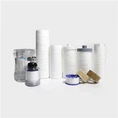
The following aspects can be considered when choosing a suitable PP melt-blown filter element:
Filtration accuracy: According to the particle size of impurities in the liquid to be filtered, select a filter element with corresponding filtration accuracy. Common filtration accuracies are 1μm, 3μm, 5μm, 10μm, 20μm, 30μm, 60μm, etc. If the cleanliness after filtration is required to be high, a filter element with higher accuracy should be selected.
Chemical compatibility: Understand the chemical properties of the filtered liquid and ensure that the filter element material is compatible with it. PP melt-blown filter elements have good chemical stability and are suitable for filtering strong acids, strong alkalis and organic solvents, but some special chemicals may still affect them.
Flow requirements: Select a suitable filter element according to the flow rate required in actual use. The flow characteristics of the filter element will be affected by factors such as its pore size, length, and outer diameter. Generally speaking, under the same conditions, the larger the outer diameter and the longer the length of the filter element, the corresponding increase in flow rate may occur.
Pollution holding capacity: A filter element with strong pollution holding capacity can accommodate more pollutants and has a relatively long service life. You can pay attention to the structural design and material of the filter element, and choose products with higher dirt holding capacity.
Temperature and pressure difference range: Confirm whether the temperature and pressure difference of the use environment are within the tolerance range of the filter element. For example, the operating temperature should usually be less than 70°C (at 0.25MPa), and the maximum positive pressure difference is generally 0.4MPa.
Filter element size: According to the size and installation requirements of the filtration equipment, select a filter element with appropriate length and outer diameter. Common filter element lengths are 10 inches, 20 inches, 30 inches, 40 inches, etc., with an outer diameter of 60-65mm and an inner diameter of 28-30mm (but the specific size may vary from manufacturer to manufacturer). It should be noted that if the outer diameter is too large, it may not fit into the filter bottle, and if it is too small, it may lead to insufficient filtration; if the inner diameter is too large, the filtration effect may be poor, and if it is too small, it may affect the water flow rate.
Brand and quality: Choose well-known brands and products with reliable quality. You can refer to the product's reputation, user reviews, and related certifications. High-quality filter elements are usually more guaranteed in terms of material, manufacturing process and performance.
Observe the appearance of the filter element: The appearance of a high-quality PP melt-blown filter element should be free of damage or deformation, with even fiber distribution and good texture. The quality of the filter element can be roughly judged by "first whether the texture is flat, second whether the wire drawing is even, third whether the wire winding is compact, and fourth whether there is any residue falling off".
Hands-on experience: Weigh the weight of the filter element by hand. The heavier one may have a larger fiber density and relatively better quality; pinch the filter element. The one that is not easy to deform and has strong compressibility usually has a larger fiber density and better quality.
Price factor: On the premise of meeting the filtering requirements, you can compare the prices of different brands and suppliers, but you should not only use price as the only criterion for selection, but also consider the quality and performance of the filter element comprehensively.
Before purchasing, if possible, you can consult the supplier for more detailed information about the filter element to ensure that you choose the PP melt-blown filter element that best suits your needs. At the same time, correctly install and use the filter element according to the equipment requirements, and replace the filter element in time according to the actual use situation to ensure the filtering effect and the normal operation of the system. When the filtered water flow rate is significantly reduced, the pressure difference reaches a certain value, or the filter has been used for a long time, it is usually necessary to replace the filter element. The specific replacement cycle needs to be adjusted according to factors such as water quality and frequency of use.
https://www.angefilter.com/