

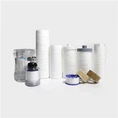
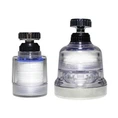
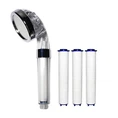
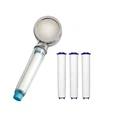
The principle of handheld shower water filter mainly involves two core mechanisms: physical filtration and chemical adsorption. The following is a detailed introduction for you:
1. Principle of physical filtration
The physical filtration part of the handheld shower water filter is mainly achieved through specific filter materials. The common filter material is PP cotton (polypropylene fiber). PP cotton has a loose and porous structure, and its fibers are interwoven to form countless tiny pores. When the water flows through the PP cotton, large particles of impurities in the water will be intercepted. These impurities include but are not limited to mud, rust, suspended particles, etc. For example, the rust particles that may be carried in tap water are much larger than the size of the pores of PP cotton. When the water flows through PP cotton, the rust particles will be blocked in the outer layer of PP cotton and cannot continue to move forward with the water flow, thereby achieving the initial filtration of these large particles. This physical filtration method can effectively remove insoluble matter that is visible to the naked eye or larger in size in the water and reduce the turbidity of the water.
2. Principle of chemical adsorption
Chemical adsorption is the key link in the function of handheld shower filter, which mainly relies on activated carbon. Activated carbon is a material with a highly developed pore structure, and its specific surface area can reach hundreds or even thousands of square meters per gram. In the water filter, when water containing impurities flows through the activated carbon, the micropores and chemical functional groups on the surface of the activated carbon begin to play a role. For residual chlorine in water, activated carbon can adsorb it through chemical reactions. Residual chlorine exists in the form of hypochlorous acid and hypochlorite in water, which react with the active sites on the surface of activated carbon and are fixed on the activated carbon. At the same time, activated carbon also has a certain adsorption capacity for heavy metal ions in water, such as mercury, lead, cadmium, etc. These heavy metal ions will form chemical bonds or physical adsorption with the functional groups on the surface of activated carbon, and thus be removed from the water. In addition, activated carbon can also adsorb organic pollutants in water, such as pesticide residues, volatile organic compounds, etc. These substances will be captured by the micropores of activated carbon, improving the smell and quality of water, making shower water safer and healthier.
If you are interested in learning more about the principles of handheld shower water filters, etc., please pay attention to www.angefilter.com and start your efficient journey. We look forward to working with you to provide customized product solutions for your company.