

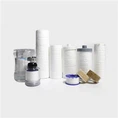
The following are factors to consider when selecting PP string wound filter cartridge:
1. Filtration accuracy
Filtration accuracy is the primary consideration. If it is for preliminary filtration of drinking water to remove large particles of sand, rust, etc., a 10-20μm filter element can be selected; if it is used for fine filtration of liquid medicine in the pharmaceutical industry, a 1-5μm or even smaller filter element may be required. Different application scenarios, such as ultrapure water preparation in the electronics industry and syrup filtration in the food and beverage industry, have specific requirements for filtration accuracy. It is necessary to ensure that the accuracy of the selected filter element can meet the corresponding filtration purpose, and pay attention to its accuracy stability under long-term use and different working conditions.
2. Pollution holding capacity
Pollution holding capacity is directly related to the service life and maintenance cost of the filter element. When dealing with media with high impurity content, such as industrial wastewater or chemical raw materials containing more particulate matter, a PP string wound filter cartridge with strong pollution holding capacity should be selected. This usually depends on the structural design of the filter element, such as the density and number of layers of fiber winding. Generally speaking, filter elements with tightly wound fibers, many layers, and large internal space can hold more dirt, maintain better filtering effects for a longer period of time, and reduce the inconvenience and cost of frequent filter element replacement.
3. Chemical compatibility
The main material of PP string wound filter cartridges is polypropylene, but the chemical properties of filter media vary. If you are filtering acidic or alkaline solutions, make sure that the filter element has good tolerance to the pH. For organic solvents, make sure that the PP material will not be dissolved or corroded.
4. Flow and pressure requirements
Select a suitable PP string wound filter cartridge according to the design flow of the filtration system. If the flow requirement is large, you need to choose a filter element that can meet the flow requirement under the corresponding pressure, and consider its pressure resistance. In high-pressure filtration systems, such as high-pressure liquid filtration in some industrial processes, you need to choose a filter element with a high-strength skeleton (such as a stainless steel skeleton) to withstand the system pressure, prevent the filter element from deforming and rupturing under high pressure, and ensure the normal filtration process.
5. Size and installation method
The size of the filter element must match the installation space of the filter, including parameters such as outer diameter, inner diameter and length. In addition, the installation method should be convenient. For example, the spin-on filter element is more convenient to install and remove, which can improve the efficiency of replacing the filter element and reduce the difficulty of maintenance.
6. Cost and service life
The relationship between cost and service life should be considered comprehensively. You can't just look at the purchase price, but should evaluate the cost-effectiveness of the filter element based on its expected service life in a specific filtering environment, and choose a PP wirewound filter element with lower long-term use cost.
If you want to know more, please contact ANGE Environmental Technology. Our professional technical team can tailor the solution you need according to your different needs.
https://www.angefilter.com/